getdigitalug
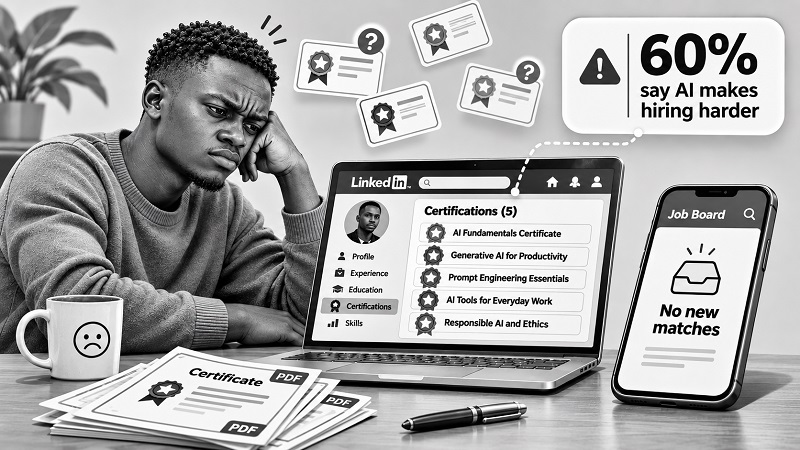
You finished five AI courses, added the certificates to your LinkedIn, and updated your CV. Weeks go by. No interview invitations. No recruiter messages. Nothing.
Job seekers across Uganda and beyond are hitting this same wall, and the problem isn’t that AI certificates don’t matter. It’s that many of the certificates people collect don’t prove anything useful to the people doing the hiring. AI skills show up on more job postings every month, and employers have gotten sharper at separating a certificate that represents real learning from one that just proves you clicked through some videos.
Before you spend another weekend chasing your next credential, here are a few things worth knowing.
Why Your Certificate Stack Isn’t Landing Interviews
The number of AI certificates available online has exploded in the past two years. Udemy, Coursera, LinkedIn Learning, and dozens of smaller providers all offer courses ending with a certificate. Some take weeks of focused study. Others you can knock out in an afternoon.
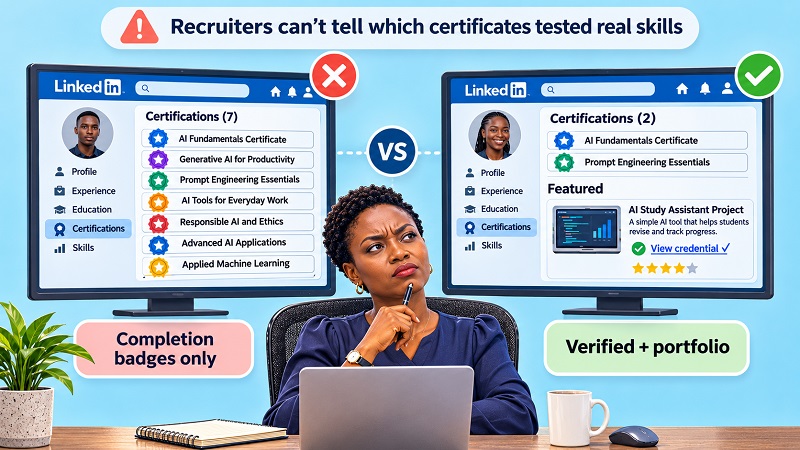
But from a recruiter’s desk, they all look the same on a LinkedIn profile. A certificate from a rigorous, proctored exam sits right next to one you earned by watching a two-hour video and answering a five-question quiz. Hiring managers who see several AI certificates listed and can’t verify what skills were actually tested? They move on to the next candidate.
And this isn’t a minor credibility gap. According to Western Governors University’s Workforce Decoded 2026 report, 60 percent of hiring professionals say AI is making it harder to evaluate candidates’ real skills. Unproctored completion certificates are losing credibility. Rigorous, scenario-based credentials that require real problem-solving are the ones gaining ground.
What Makes an AI Certificate Worth Putting on LinkedIn
Not every AI certificate helps your job search. The ones that carry weight share a few traits worth paying attention to.
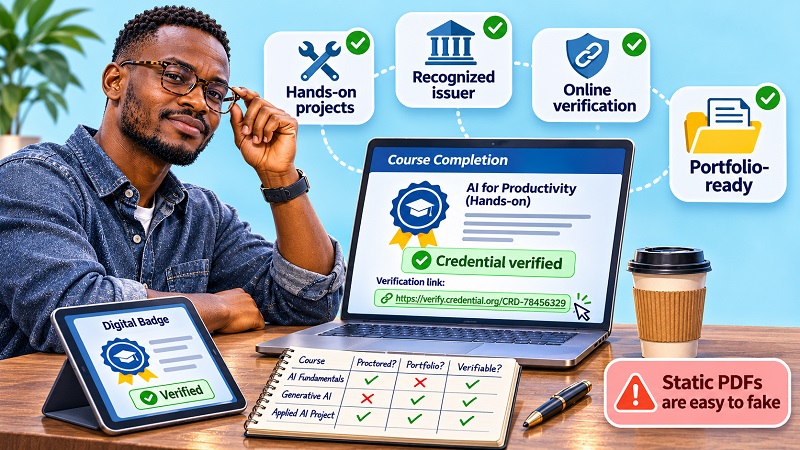
They come from courses teaching practical application, not memorized definitions. If you finished a course and can explain a concept but can’t actually use AI to complete a task your employer would care about, that certificate isn’t pulling its weight. The strongest credentials come from programs where you build something, solve a real problem, or show a skill under assessment conditions. If you’re looking for an AI certificate for LinkedIn that reflects genuine ability, focus on courses that require you to apply what you’ve learned. Not just recall it.
The issuing organization matters a lot too. Certificates from Google, IBM, Microsoft, AWS, and recognized universities carry more weight than those from unknown platforms. Recruiters know these names and tie them to a certain quality standard. A certificate from a platform nobody’s heard of raises more questions than it answers.
Then there’s the verification question. If a recruiter can click a link and confirm your credential is real, that gives you a real edge. As eLearning Industry points out, most certificates issued by online platforms today are static PDF documents that are easy to claim and hard to trust. Modern credentials with verification links, credential IDs, or digital badges offer far stronger proof than a PDF anyone could edit in five minutes.
What Employers Want When They See “AI Skills” on a Profile
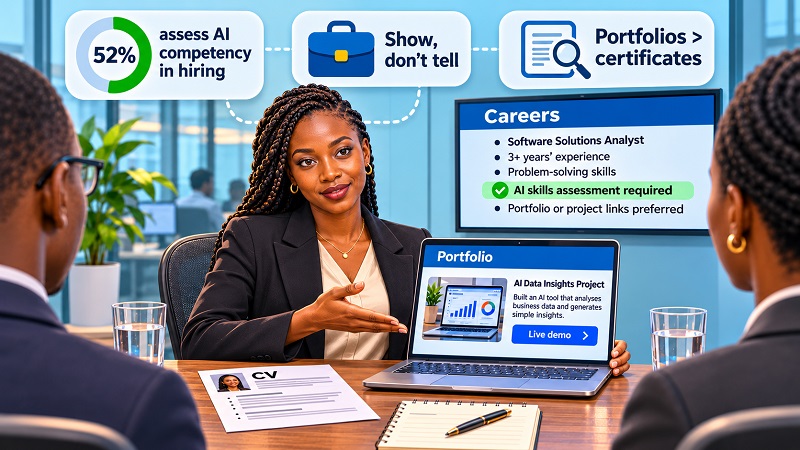
Hiring for AI-related roles has shifted fast. A few years ago, listing AI skills on your profile was enough to get noticed. Now almost every applicant claims some level of AI knowledge, and employers aren’t trying to find people who know about AI anymore. They’re trying to find people who can prove it.
According to Built In, 52 percent of employers now actively assess AI competency during the hiring process. They want evidence through portfolios, projects, and verifiable credentials. A list of course completions doesn’t clear that bar on its own.
This shift matters in Uganda too. More Ugandan businesses are adopting AI tools for customer service, data analysis, marketing, and financial management, and local employers are starting to ask the same questions international companies ask: can this candidate actually do the work? Can they show me something they’ve built, solved, or improved using AI?
Uganda’s education authorities have been wrestling with the broader problem of unverifiable qualifications for years already. The National Council for Higher Education (NCHE) and UNEB have had to address forged documents and questionable credentials across the education system. The online certificate problem is different in nature, but the underlying issue is identical: a credential only has value when someone can confirm what it represents.
How to Pick an AI Certificate That’s Worth Your Time
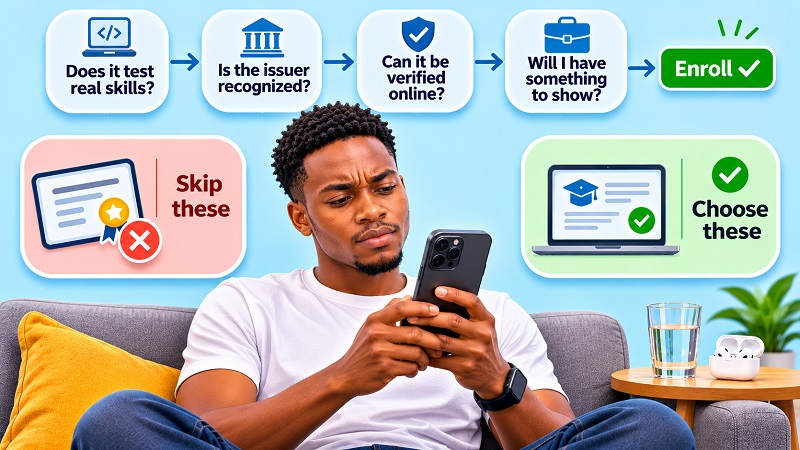
Before you enroll in your next AI course, ask yourself a few honest questions:
- Does this course require hands-on projects or a real skills assessment? If the only requirement is watching videos, that certificate won’t stand out.
- Is the issuing platform or organization widely recognized by employers? Check job postings in your target field and see which certificates they actually mention.
- Can the credential be verified online? Look for courses that issue digital badges or include verification links you can share.
- Will you be able to show what you learned after completing the course? If you can’t point to a project, a tool you built, or a problem you solved, the certificate alone won’t tell your story.
For job seekers in Uganda working with limited data or a modest device, look for courses that are mobile-friendly and don’t need heavy downloads. Several reputable platforms, including Google and Coursera, offer courses that work well on smartphones and have free options for learners who can’t afford paid plans.
Don’t stop getting certificates. Stop collecting them for the sake of collecting them.
One strong credential backed by a real project you can talk about in an interview will do more for you than a dozen completion badges stacked on your profile.
Turn Your Next Certificate Into Proof, Not Just a Badge
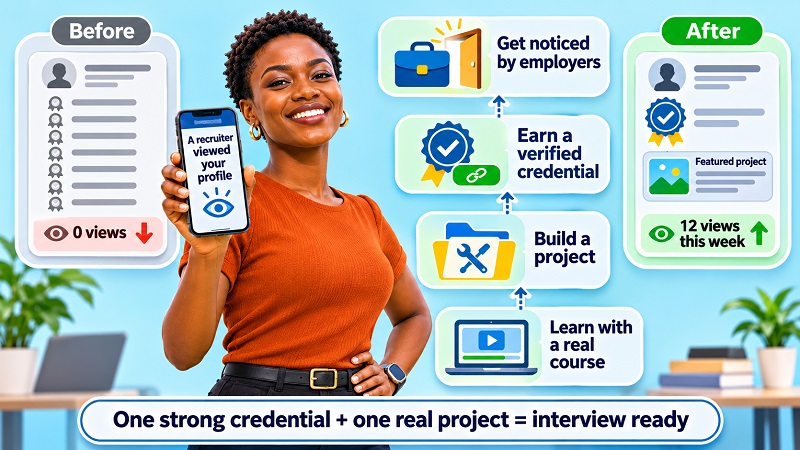
Employers aren’t short on applicants who claim AI skills. They’re short on people who can back that up.
So when you’re picking your next course, think about what you want that certificate to say about you. Choose a program that demands real effort, teaches skills you’ll actually use, and gives you something concrete to point to. And instead of rushing straight to the next course, spend time building a small project that shows what you’ve learned. A credible credential paired with visible proof of skill is what gets you into interview rooms. The pile-of-badges approach is what keeps the inbox quiet.
Your next AI certificate should open a door, not just add a line to your profile.

 getdigitalug