getdigitalug

Young Ugandans without degrees are getting hired. Not because employers suddenly dropped their standards, but because what counts as “qualified” is changing fast. Prove you can do something and a growing number of companies won’t ask where you went to school.
About 700,000 people enter Uganda’s labor market every year, a figure cited by government officials and the National Planning Authority. That number has barely moved. What’s changed is the reality on the other side: graduates with degrees can’t land formal jobs either. People who didn’t finish university, or never enrolled, are watching that struggle unfold. And the question they’re asking is fair. If qualifications alone aren’t enough, what actually gets you hired?
Answers are forming across Kampala’s tech hubs, on freelancing platforms, and inside the informal networks where young Ugandans teach themselves skills and get paid for results. What follows is a close look at how that’s playing out and the new paths it’s creating.
What the Unemployment Numbers Actually Show
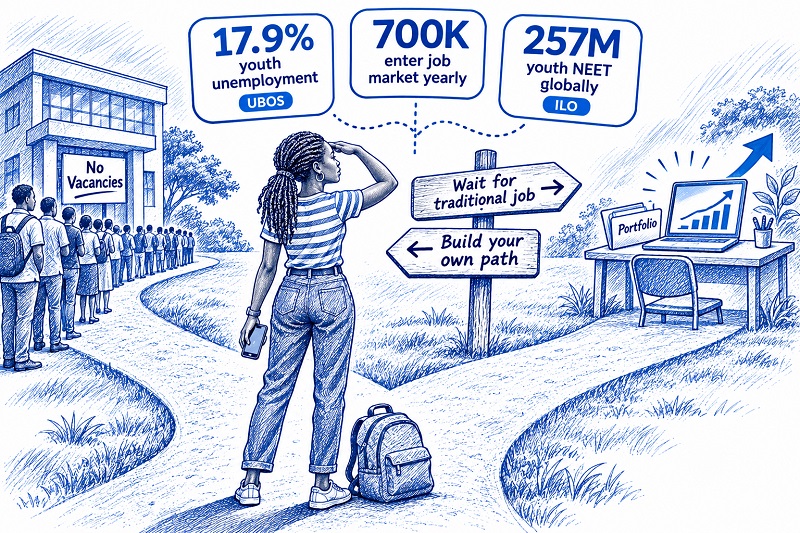
Uganda’s youth unemployment rate sits at 17.9%, according to the 2025 Labour Market Survey by the Uganda Bureau of Statistics (UBOS). In urban areas, it’s worse: 18.7%. The formal economy can’t absorb the number of people who need work.
Globally, the story looks familiar. A 2026 report from the International Labour Organization (ILO) found that youth unemployment worldwide rose to 12.4% in 2025, with about 257 million young people not in employment, education, or training. Job creation in sub-Saharan Africa still isn’t keeping up with the region’s fast-growing youth population.
For young Ugandans without degrees, these figures say one thing clearly: waiting for a traditional job offer to show up isn’t a strategy anymore.
Degrees Matter Less Than Most People Think
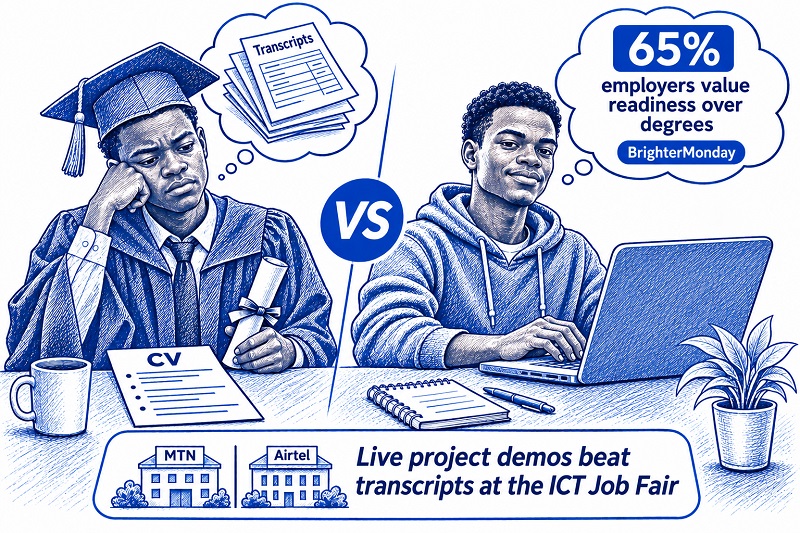
Something real is shifting in how Ugandan employers approach hiring. According to BrighterMonday Uganda’s research on youth employment, approximately 65% of employers now say workplace readiness matters more than holding a specific university degree. At the National ICT Job Fair, MTN Uganda and Airtel recruited front-end developers based on live project demonstrations. Not transcripts. Working code.
That doesn’t mean you can toss degrees out entirely. Banks still want them. So do some government agencies. But for a growing number of roles in tech, digital marketing, content creation, e-commerce and customer support, what you can show beats where you studied.
Freelancing clients care even less about formal credentials. A business owner in Nairobi or London hiring a social media manager or data entry specialist wants to see past work samples and reliability. A portfolio of finished projects says more than a certificate on a wall.
Gig Work as the First Rung

Gig work in Uganda has expanded fast. Research has found that nearly 60% of Ugandan youth are engaged in some form of it, from ride-hailing and delivery services to e-commerce and online freelancing.
For people without degrees, this kind of work does two things at once. It puts money in your pocket now, and it builds a track record for later. A freelancer who completes 20 paid projects on Upwork or Fiverr has something concrete to point the next client toward. Every finished job is proof you can deliver.
The ILO’s Online Gig Work Pilot in Uganda ran from 2024 to 2025, training over 200 young people and refugees in digital freelancing skills. By early 2026, 70 graduates from that program had landed a combined 148 paid online assignments. Those numbers are small. But they show the model works.
And digital platforms are dissolving geography. Young people in Gulu, Mbarara and Mbale can take on the same remote projects as someone sitting in Kampala, provided they’ve got internet access and the right skills.
Free Training That Teaches Marketable Skills
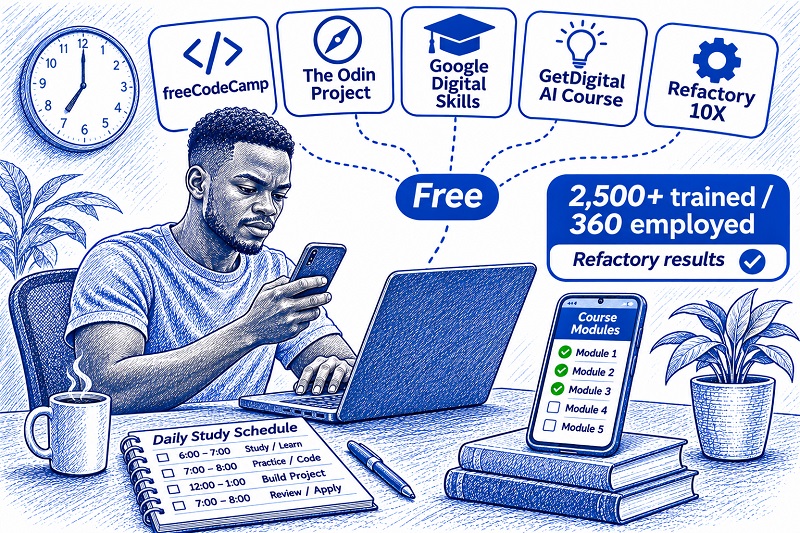
You don’t need university-level tuition to learn things people will pay you for. Several free and affordable options exist for young Ugandans right now.
Platforms like freeCodeCamp and The Odin Project offer structured, self-paced curricula in web development and programming at no cost. Google’s Digital Skills for Africa covers the basics of digital marketing, online advertising and data analysis. Anyone curious about artificial intelligence can start with free AI skills training in Uganda through GetDigital, an introductory course that doesn’t require a coding background.
Local programs are producing real results. Refactory Academy’s 10X Program, run in partnership with the Mastercard Foundation, has trained more than 2,500 young people in advanced digital skills. As of mid-2026, at least 360 participants had secured employment. The UNDP’s Skills for Digital Jobs initiative graduated 144 young Ugandans in data science, cybersecurity and cloud computing, with nearly half moving into jobs afterward.
Government efforts are expanding too. The Ministry of ICT and National Guidance has a national strategy targeting over 100,000 digital jobs by 2030 through skills-based training pathways. By mid-2025, over 10,000 Ugandans had already completed digital skills training through government programs.
I’ll be honest, though: free resources are powerful but they demand real self-discipline. Setting a daily routine and building actual projects as you go makes the difference between finishing a course and becoming someone worth hiring.
A Portfolio Does What a CV Can’t

If you don’t have a degree, the standard CV format works against you. It puts a spotlight on the gap in formal education instead of showing what you’re capable of.
A portfolio flips that.
Web developers can display three to five working sites or apps they’ve built. Graphic designers can share logos, posters or social media content they’ve created. A virtual assistant can document the tasks they’ve handled and the outcomes. Someone learning data analysis can publish a project on GitHub showing how they cleaned and visualized a dataset.
Your portfolio becomes your diploma. It proves ability in a way no credential can fake, and young Ugandans who pair self-taught skills with a visible body of work are getting hired at companies that used to require degrees as a baseline.
A Practical Starting Point
If you didn’t attend or finish university and you want a path forward that’s working for people right now, consider this:
- Pick one skill area with clear demand: web development, digital marketing, graphic design, data entry, or AI tools.
- Commit to a free learning platform and follow its curriculum for at least three months. Consistently.
- Build at least three real projects as you learn. Not tutorial exercises.
- Put together a simple online portfolio using a free website builder or GitHub profile.
- Apply for small gig projects on freelancing platforms to earn while you build a track record.
- Join local tech communities, both online and at in-person meetups, where you’ll find mentorship and job leads.
None of this is easy. It takes discipline and a willingness to push through real frustration. But thousands of young Ugandans are already making it work because they decided that what they could do mattered more than what paper they held.
The Degree-to-Job Pipeline Is Broken. That’s an Opening.
The old deal was simple. Get a degree, get a job. That deal has fallen apart, and not just in Uganda. Employers around the world are rethinking what qualifications actually tell them about someone’s ability to perform.
For young Ugandans without degrees, this shift is an opening worth taking seriously. The digital economy doesn’t care where you went to school. It cares what you can build, what problems you can solve, and whether you deliver on time. People who invest in practical skills, put together a portfolio and get themselves into the market are discovering it’s more open than it looks from the outside.
This path isn’t traditional. But for a generation entering a labor market that can’t absorb everyone through formal channels, building skills and proving yourself through work you can point to might be the most realistic route available right now.

 getdigitalug