getdigitalug

Scroll through job listings in Kampala these days and you’ll spot it sooner or later. “AI literacy preferred.” Attached to a marketing coordinator role. An operations assistant. A claims officer at an insurance company. None of these are tech jobs.
That line is showing up more often, and it’s catching qualified professionals across Uganda off guard. AI isn’t some faraway concern for programmers in Nairobi or Silicon Valley. Right here in Uganda, it’s already changing how people work, how they earn, and who gets the job. The question isn’t whether you’ll need AI skills eventually. It’s how much not having them is costing you today.
The rest of this covers where things stand right now and what you can do about it.
AI Already Has a Footprint in Ugandan Workplaces

Marketing agencies in Kampala use AI to draft social media posts, generate ad copy and analyze campaign data in minutes rather than days. Insurance companies are digitizing claims processing and exploring AI-assisted underwriting to speed up decisions that used to drag on for weeks. Farmers rely on mobile apps powered by AI to track weather patterns, monitor pest outbreaks and check commodity prices before planting.
Young entrepreneurs are getting in on this too. Across the country, Ugandans are building businesses around AI-powered content creation, online education and digital marketing. They go up against larger, better-funded companies and win clients because they deliver faster and cheaper. That kind of competitive edge used to require serious capital. Now it takes skill and a willingness to learn new tools.
A report that takes one person a full week to complete? A colleague who knows how to work alongside AI tools finishes it in hours. Employers see this gap clearly. They’re factoring AI literacy into hiring and promotion decisions now, even for roles that have nothing to do with writing code.
What the Data Points To
This goes well beyond a handful of tech-forward offices in the capital. GSMA research presented at the Digital Africa Summit estimates Uganda could create nearly 1.8 million new jobs and generate UGX 14.6 trillion in additional economic value by 2030, provided the right digital reforms happen. But those gains depend entirely on whether enough Ugandans have the skills to fill those positions.
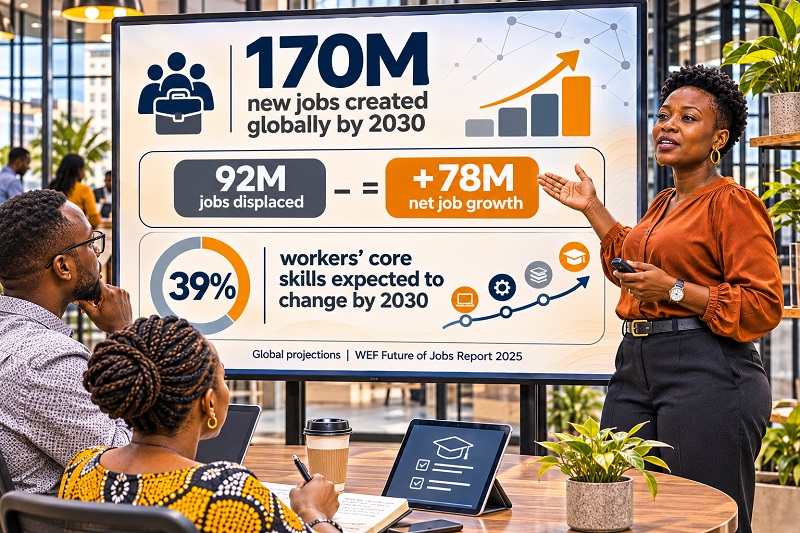
Globally, the pressure is tightening. The World Economic Forum’s Future of Jobs Report projects 170 million new jobs will be created worldwide by 2030, while 92 million existing positions get displaced. Net gain: 78 million jobs. But only for workers who adapt. That same report found 39% of core job skills will change by the end of the decade, and close to 60% of the global workforce will need reskilling.
Uganda’s version of this challenge is more specific. The Economic Policy Research Centre estimates roughly 26% of jobs in low-income countries face exposure to AI-related disruptions. The country has set ambitious targets: equipping 3 million people with AI skills and creating 1 million AI-centered jobs by 2030. Yet a national skills assessment already identified a shortage of trained workers as the single biggest barrier to AI adoption.
For individual workers, these big numbers show up in smaller, personal ways. A promotion going to the person who picked up AI skills. A freelance contract lost to a competitor who delivers faster. A job description you scroll past because you can’t meet the requirements.
How to Start Closing the Gap

You don’t need a computer science degree for this. You don’t need expensive training programs or even a laptop. What you need is to learn how to use AI tools in work you’re already doing, not build them from scratch. That part is simpler than most people expect.
A free introductory course is the most practical place to start. GetDigital offers free AI skills training that covers what AI tools can do, how to write effective prompts and where these tools fit into everyday tasks. You can complete it on a smartphone with a basic data connection, which puts it within reach for most working Ugandans. Starting with structured material saves a lot of the confusion that comes from trying to figure things out alone.
Once you’ve built that foundation, start practicing in your actual work:
- If you write reports or proposals, use AI to help with research and first drafts.
- If you manage social media or marketing, experiment with AI tools for content ideas and scheduling.
- If you handle customer records or data, explore how AI can speed up routine analysis.
- If you work in customer service, try AI-powered chatbots to handle common questions.
As the International Labour Organization notes, employers rarely want AI expertise by itself. They want people who can combine practical AI knowledge with professional skills and industry experience they already have. Your years in your field still matter. AI literacy makes them worth more.
Stop Waiting for the Market to Move Without You

The AI skills gap in Uganda is real and it’s growing. But it isn’t permanent for anyone willing to take a first step. Workers and entrepreneurs pulling ahead right now didn’t start with advanced technical backgrounds. They learned the basics and applied them consistently.
Sitting this out won’t cost you everything at once. It’s gradual: one missed opportunity, one lost client, one job listing you skip because you can’t meet the requirements. Over a year, over two, those small losses stack up in ways that are tough to reverse once you’re behind. And the effort you invest in learning now will compound too, in ways that waiting simply can’t match. The people best positioned for Uganda’s growing AI economy won’t be those with the fanciest credentials. They’ll be the ones who started learning early and kept at it.
Pick one free course. Finish it this month. Start using what you learn in the work you do every day.

 getdigitalug