getdigitalug

Ugandan employers want you to use AI tools, not build them. That’s the short version of what’s happening across job boards like BrighterMonday and Fuzu right now. More postings in banking, telecoms and NGO work list “AI skills” or “proficiency with AI tools” as a desired qualification, and it catches people off guard because these aren’t software engineering roles.
The trend is real. But most people are reading it wrong, and that confusion is worth clearing up.
What “AI Skills” Actually Means on a Job Listing

Nobody’s asking you to build machine learning models or write algorithms. When a Ugandan bank, telecom company, or NGO drops “AI skills” into a job ad, they’re talking about practical ability. Can you use ChatGPT, Google Gemini, or Microsoft Copilot to draft reports faster? Can you summarize research without burning three hours on it, or pull insights from a messy dataset without waiting on someone else?
That’s the bar.
A communications officer at an NGO who uses AI to produce donor reports in half the time will get noticed. Same goes for a financial analyst flagging suspicious transactions through AI-powered tools instead of wading through slow manual reviews. The question hiring managers ask isn’t “can you code a neural network?” It’s “can you use these tools to do your job better and faster?”
The Skills Divide Behind the Job Ads

This isn’t about robots coming for anyone’s position. The reason AI skills keep appearing in listings has more to do with a widening gap between what employers need and what most graduates walk in with.
A 2026 study published in the Metropolitan Journal of Academic and Applied Research examined this directly. Researchers at Metropolitan International University surveyed over 1,200 respondents across twelve universities, schools and public institutions in Uganda. Their conclusion: AI readiness has a significant effect on employment outcomes, but that effect works indirectly through education quality and skills preparation. In practical terms, AI’s biggest impact on Uganda’s youth job market runs through the skills divide, not through direct job displacement.
The Economic Policy Research Centre (EPRC) reached a similar finding. In its analysis of AI and employment, the EPRC noted that lack of relevant skills, including computer and AI literacy, is a direct cause of youth unemployment. Uganda’s national unemployment rate sits at 12.6%. Over half of young Ugandans are neither employed nor in education. Those numbers make closing the digital skills gap urgent, not optional.
For job seekers willing to act early, that gap is also an opening. Structured training is faster and more reliable than trying to cobble things together from scattered YouTube videos. A free AI course in Uganda covers the tools employers expect you to know, with organized lessons and real work applications you can practice on your own time.
Which Sectors Are Adopting AI Fastest
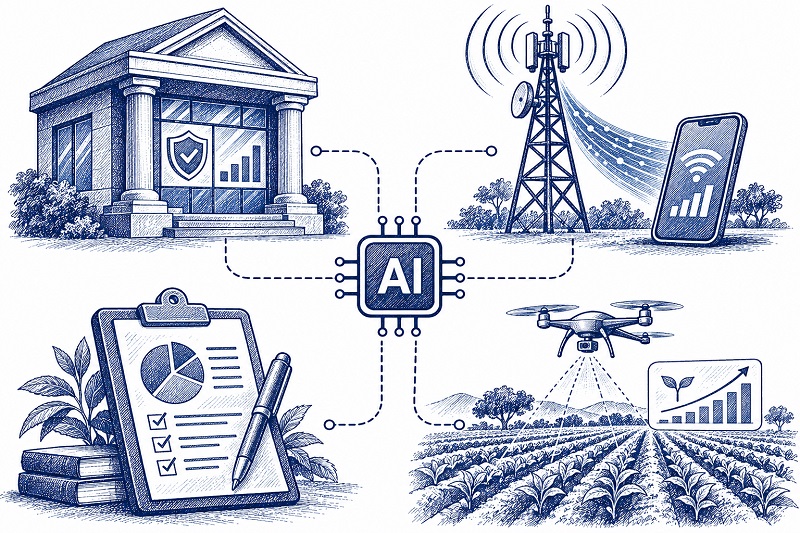
Banking and financial services are out front. In April 2026, the Uganda Institute of Banking and Financial Services (UIBFS) signed a memorandum of understanding with Vision Africa AI to expand AI and digital literacy across the financial workforce. The partnership focuses on developing employer-validated certifications in AI, data science, and cybersecurity. Ugandan banks already use AI for credit scoring, customer service, and fraud detection. One Kampala-based institution reported a 70% reduction in fraud cases after deploying AI-powered detection earlier this year.
Telecoms are close behind. MTN Uganda and Airtel Uganda actively hire data analysts, data scientists and professionals who can work with AI tools for mobile money operations, network optimization, and customer insights.
NGOs and development organizations now regularly include AI tool proficiency in job requirements for research, monitoring and evaluation, communications and data analysis roles.
And it goes beyond those three. Agritech companies like EzyAgric and M-Omulimisa apply AI for crop advisory services, while health organizations use AI-powered tools to analyze medical data and track disease outbreaks.
What Level of Knowledge Actually Gets You Hired

For most roles outside dedicated tech teams, the knowledge that satisfies hiring managers is practical, not theoretical:
- Familiarity with at least one generative AI tool (such as ChatGPT, Gemini, or Claude) for writing, research, and summarization
- The ability to write clear, specific prompts that produce useful outputs
- Basic awareness of how AI handles data and where its limitations lie
- Comfort using AI features built into workplace software like Microsoft 365 or Google Workspace
- A willingness to keep learning as the tools develop
Explaining how a large language model works under the hood won’t come up. What matters is showing you can use AI to solve real problems, save time and improve the quality of your output. The World Economic Forum’s Future of Jobs Report 2025 found that 63% of employers globally identified skills gaps as the primary barrier to business transformation, and 77% are committed to reskilling their teams to work alongside AI. Ugandan employers are following the same pattern.
Get Ahead While the Window Is Open
AI skills in Ugandan job ads aren’t a passing phase. Banks are digitizing operations. Telecoms keep expanding data-driven services. NGOs are chasing efficiency gains with tighter budgets. The demand for people who can work confidently with AI tools will keep growing across all of them.
You don’t need to become an AI engineer. You need to become someone who uses AI well in their actual work. Start with structured training and practice on real tasks. Be ready to show potential employers what you can do. Right now, most applicants can’t demonstrate real proficiency with these tools. That won’t last forever, but while it’s true, it’s an advantage worth claiming.

 getdigitalug